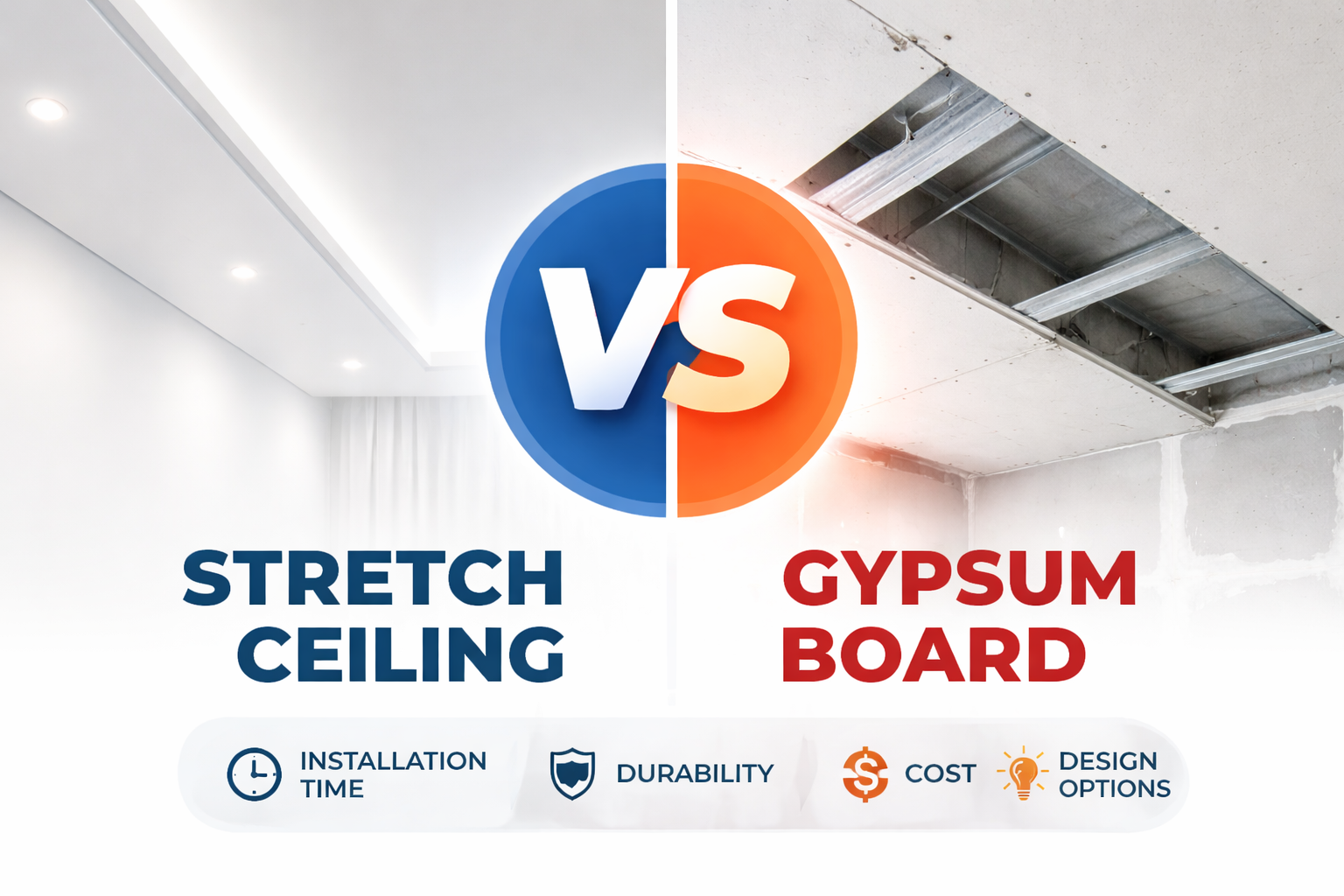
Stretch Ceiling vs Gypsum Board: Which Is Better?
When choosing a ceiling system for residential or commercial interiors, two of the most common options are stretch ceilings and gypsum board ceilings. Both solutions are widely used, but they differ significantly in installation time, durability, design flexibility, and long-term maintenance.
This guide provides a clear, practical comparison to help you decide which ceiling system best suits your project.
What Is a Stretch Ceiling?
A stretch ceiling is a lightweight membrane made from PVC or polyester fabric, installed below the structural ceiling using a perimeter track system. The material is stretched and tensioned to create a perfectly smooth, seamless surface.
Stretch ceilings are often used in modern interiors and are especially popular for projects requiring clean lines, integrated lighting, or fast installation.
What Is a Gypsum Board Ceiling?
A gypsum board ceiling is constructed using metal framing and plasterboard panels that are fixed, jointed, plastered, sanded, and painted. This system has been used for decades and is commonly chosen for traditional ceiling designs or complex architectural shapes.
Installation Time
Stretch Ceiling
- Installed in one day in most cases
- No plastering, sanding, or drying time
- Minimal dust and disruption
Gypsum Board
- Multi-stage process
- Requires framing, boarding, jointing, plastering, sanding, and painting
- Can take several days or weeks, depending on complexity
Winner: Stretch ceiling
Durability and Lifespan
Stretch Ceiling
- Resistant to cracks and sagging
- Flexible material adapts to building movement
- Long service life with minimal maintenance
Gypsum Board
- Prone to cracks over time
- Sensitive to humidity and structural shifts
- Requires periodic repainting or repairs
Winner: Stretch ceiling
Design and Lighting Options
Stretch Ceiling
- Available in matte, satin, glossy, translucent, and printed finishes
- Ideal for backlit ceilings, hidden LED systems, and decorative lighting
- Seamless appearance with unlimited color choices
Gypsum Board
- Limited surface finishes
- Decorative shapes possible but require complex construction
- Lighting integration requires additional cutting and framing
Winner: Stretch ceiling
Maintenance and Repairs
Stretch Ceiling
- Easy to clean
- Can be demounted and reinstalled if access above the ceiling is required
- Does not require repainting
Gypsum Board
- Repairs often involve cutting, patching, plastering, and repainting
- Dusty and time-consuming maintenance
Winner: Stretch ceiling
Cost Comparison
Stretch Ceiling
- Higher initial material cost
- Lower labor and installation time
- Minimal long-term maintenance expenses
Gypsum Board
- Lower initial material cost
- Higher labor costs
- Ongoing maintenance and repainting over time
Overall: Stretch ceilings often provide better long-term value.
Moisture and Environmental Resistance
Stretch ceilings perform well in environments where humidity or temperature changes are present. The material does not absorb moisture and maintains its appearance over time.
Gypsum board ceilings can deform or deteriorate in humid conditions if not properly treated.
Final Verdict
While gypsum board ceilings remain a traditional option, stretch ceilings offer clear advantages in speed, durability, design flexibility, and long-term maintenance. They are particularly well-suited for modern interiors, commercial spaces, and projects that require clean finishes and advanced lighting integration.
To see how stretch ceiling systems are used in real projects, you can explore professional installations and applications on specialized ceiling design platforms such as soffitdesign.ae.